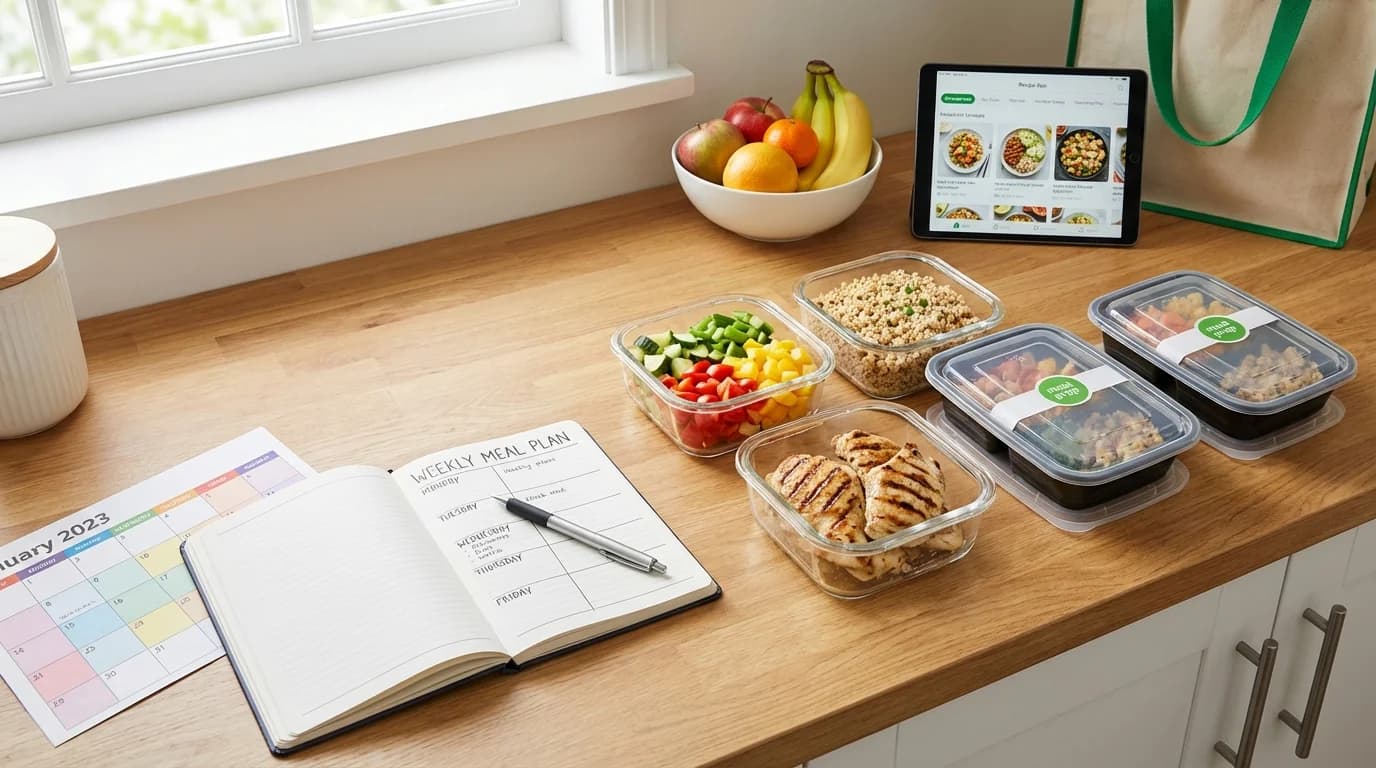
Meal planning sounds like something organized people do. People with color-coded binders and a whiteboard and a meal-prep Sunday that runs like clockwork. If that's not you right now — if you're more "what's in the fridge at 6 PM" than "I planned this on Sunday" — this guide is for you.
Key Takeaways
- Your first meal plan should cover only 4-5 dinners, not all seven nights
- Start with recipes you already know — the goal is building a habit, not expanding your repertoire
- A digital meal planner that generates the shopping list automatically removes the biggest friction point
- The system gets faster and easier every week you use it
Meal planning for beginners doesn't require a binder, a whiteboard, or a three-hour Sunday prep session. It requires about 20 minutes of thinking at the start of the week, a short shopping list, and the willingness to follow a plan most nights even when takeout sounds easier.
That's it. Here's how to do it.
What Meal Planning Actually Is (And Isn't)
Before we talk about how to start, let's be clear about what beginner meal planning means in practice.
What it is:
- Deciding what you'll eat for dinner most nights of the week before the week starts
- Shopping for those specific meals so the ingredients are actually in your kitchen
- Having a plan you can look at on Tuesday night instead of staring at the fridge
What it isn't:
- Cooking everything on Sunday
- Planning every meal of every day
- Using complicated spreadsheets or apps with steep learning curves
- Being rigid about every single night
New meal planners often give up because they try to do too much too fast. They plan seven dinners, three lunches, and breakfast for a week, spend two hours prepping on Sunday, and then Wednesday's plan falls apart because they got home late. They conclude they're "bad at meal planning" and stop.
You're not bad at meal planning. You tried to run before you could walk. Start with dinner, start with four or five nights, and build from there.
Before You Start: Gather Your Recipes
Meal planning only works if you have a collection of recipes to pull from. "Collection" doesn't mean 500 saved recipes — it means 10-15 dinners you know how to make or can follow a recipe for.
Before your first planning session, gather your go-to dinners in one place. These are:
- Things you make regularly without looking anything up
- Things you've made a few times and liked
- A few recipes from food blogs or family members you want to try
The easiest way to do this is to save them all to MyRecipe. You can import recipes directly from any food blog URL (the importer strips the ads and backstory, saving just the ingredients and steps), scan handwritten recipe cards with your phone camera, or type your own recipes in. All free, all in one place, searchable on any device.
If you're not ready for a digital tool yet, a plain notes app works for a first week. Just get the recipe titles and key ingredients somewhere accessible on your phone so you can reference them during planning.
Step 1: Plan Your First Week (20 Minutes)
Your first meal plan should be the simplest possible version. Here's how to do it.
Choose 4-5 Dinners, Not 7
You're learning a new habit. Leave yourself room for one or two nights that don't go to plan. If you plan five dinners and execute three, you still had three nights where you had a plan and groceries. That's a win. If you plan seven and fall short on three nights, it feels like failure even though it's essentially the same result.
Five dinners is the right starting number.
Pick Recipes You Already Know
Your first week is not the week to try three new recipes. Pick dinners you've made before — things where you know roughly what's in them and how long they take. If you want to try one new thing, pick one. Just one.
New recipes on a busy Tuesday add mental load you don't want when you're still learning the habit. Familiar recipes mean you're not consulting the instructions every two minutes while also wrangling kids or coming down from a stressful workday.
Think About Your Week
Before assigning recipes to nights, look at your calendar:
- Which nights are you home earliest? Those get the quickest dinners.
- Which nights do you have the most time? Those can handle something that takes 45 minutes.
- Is there a night when you'll definitely be too tired to cook? That's your leftover night or "cereal is dinner" night. It's in the plan.
Assign roughly: two easy weeknight dinners (under 30 minutes), one or two medium ones (30-45 minutes), one that can be prepared in advance or uses leftovers, and leave two nights open.
Write It Down Somewhere Visible
For your first week, write the plan on a sticky note, whiteboard, or the notes app on your phone. It doesn't need to be a beautiful calendar. It needs to be something you'll actually look at on Monday night when you're deciding what to cook.
If you're using MyRecipe's meal planner, assign recipes to each day in the app — then the plan is on your phone, shared with anyone in your household, and the shopping list generates automatically from the assigned recipes.
Step 2: Build Your Shopping List
This is the step where most beginner meal planners stumble. The plan is fine; the shopping list is the bottleneck.
What Goes on the List
Every ingredient for every dinner that you don't currently have. That's it. Check your fridge, freezer, and pantry against each recipe's ingredient list and add only what's missing.
This sounds obvious but it's where people go wrong. They either:
- Don't check what they have and buy duplicates they don't need
- Don't build the list at all and end up at the store Tuesday without knowing what to buy
The check-before-you-shop step takes five minutes but saves 20 minutes of store confusion.
How to Build It Faster
If your recipes are saved in MyRecipe's meal planner, the shopping list builds itself automatically from all your planned recipes. Duplicate ingredients are merged — if three recipes call for onion, one combined quantity appears on the list. Items are sorted by grocery-store aisle so you don't zigzag the produce section twice.
If you're building the list manually, group items by category: produce, meat, dairy, pantry, frozen. Same principle as aisle sorting — you move through the store efficiently instead of backtracking.
Shop Once
The goal is one shopping trip that covers the full week. If you need to pick up one ingredient mid-week, fine — but the fewer the trips, the more time you've saved with this system.
Step 3: Your First Sample Meal Plan
Here's a concrete example of what a beginner meal plan looks like for a household of two to four people.
Monday: Pasta with marinara sauce and Italian sausage (Why: 20 minutes, crowd-pleaser, easy to scale)
Tuesday: Sheet pan chicken thighs with roasted vegetables (Why: mostly hands-off after 5 minutes of prep — great for a busy night)
Wednesday: Leftovers from Monday or Tuesday, or tacos with leftover chicken (Why: Wednesday is chaos. Planning for leftovers is the secret weapon.)
Thursday: Stir-fry with whatever protein you have, served over rice (Why: uses up vegetables that need cooking, fast, flexible)
Friday: Pizza — homemade, frozen, or delivered (Why: Friday is Friday. Don't try to be a hero.)
Saturday and Sunday: Unplanned. Eat leftovers, go out, or cook something relaxed.
Five nights, simple recipes, one dedicated leftover slot, two unplanned nights. This covers the week without making you a full-time meal planner on your first attempt.
Step 4: Common Beginner Mistakes (And How to Avoid Them)
Mistake 1: Planning Meals That Take Longer Than Your Available Time
If you get home at 6:30 PM and the kids eat at 7, a 45-minute recipe is too long for a Wednesday. Know your time windows per night and match recipes accordingly.
Fix: Label each planned dinner with an estimated cook time. "Monday: Pasta (20 min)." "Thursday: Roast chicken (55 min, start early)."
Mistake 2: Forgetting to Thaw Frozen Proteins
This is the single most common reason dinner plans fall apart. You planned chicken on Tuesday. Chicken is frozen. It's 5 PM.
Fix: When you write the plan on Sunday, also note when to pull things from the freezer. "Tuesday: take chicken out Monday night." A 15-second reminder prevents the most common dinner crisis.
Mistake 3: Not Having a Fallback
Life happens. The plan falls apart. You're exhausted and there's nothing ready.
Fix: Always keep two or three "emergency dinners" stocked: pasta and sauce, canned beans and rice, eggs. Factor one into your weekly plan explicitly — "Thursday: whatever's in the pantry" — so you don't feel like you failed when you use it.
Mistake 4: Planning Too Many New Recipes
New recipes take longer, require more focus, and don't always work out. One new recipe per week maximum when you're starting out.
Fix: 80% of your plan should be recipes you know. Use the one new slot strategically — try something on a weekend when time pressure is lower.
Mistake 5: Not Sharing the Plan
If you're the one who plans, your partner or household members don't know what tonight's dinner is unless you tell them. They can't help with prep if they don't know what's being made.
Fix: Put the plan somewhere visible and accessible. The MyRecipe shared meal planner shows the same calendar to every household member in real time. Your partner can start the Tuesday pasta before you're home.
Step 5: Building Your Recipe Collection as You Go
After your first week, you have five recipes you successfully cooked. Save them. After a month, you have 20 recipes — your rotation is established.
How to Expand Your Recipe Collection
Import from food blogs. When you see a recipe online that looks good, don't just bookmark it — import it to your recipe collection so it's in your meal planner when you need it. MyRecipe's URL importer works on most major recipe sites.
Save family recipes. If your mother or grandmother has recipes the family loves, save them digitally before they're lost. Scan the handwritten cards, let the OCR turn them into editable text, and add them to your collection. These recipes are part of your family's food heritage — digitizing them protects them for the next generation.
Rate what you make. After cooking any recipe, give it a quick rating and note what worked or didn't. This becomes invaluable when you're building your meal plan months from now — you'll filter to your five-star recipes and plan from there.
How Large Should Your Collection Get?
For a reliable, low-stress meal planning system, most households need about 20-30 saved recipes: enough variety to not feel repetitive (you see each recipe every 3-5 weeks), few enough that you know them well.
Once you hit 30-40 recipes, you have a genuine meal-planning library. The Sunday planning session becomes easy because you're choosing from recipes you know and love.
Step 6: Upgrading Your System Over Time
After a few weeks of basic meal planning, you might want to add layers.
Add Meal Prep
Meal prepping means doing some cooking tasks on the weekend so weeknight meals are faster. Start small: cook a batch of grains on Sunday, chop vegetables for three dinners, marinate the protein. Not a full Sunday prep session — just 30-45 minutes of advance work that saves time every night.
Build a Freezer Stock
Some meals freeze beautifully. When you make soups, stews, casseroles, or baked pasta, make double and freeze half. After a month of this, you have backup dinners for the nights when the plan completely falls apart. Freezer meal prep is the upgrade that makes meal planning genuinely resilient.
Plan for the Budget
Once you're comfortable planning dinners, extend the system to budget awareness. Know roughly what each dinner costs per serving. Build your rotation to include at least two budget-friendly dinners per week (beans and rice, eggs, pasta). Feeding a family on a budget becomes much easier when the meal plan has explicit cost awareness built in.
Use a Shared Planner
If you cook for others, a shared planner is transformative. MyRecipe's Family plan gives every household member real-time access to the meal calendar and shopping list. When your partner is at the store, they can see exactly what to buy. When they're home first, they can start dinner from the plan. The meal planning burden distributes across the household instead of sitting with one person.
Your First Week: A Simple Action Plan
Here's exactly what to do if you're starting from zero.
Tonight or tomorrow:
- Write down 8-10 dinners you already know how to make
- Save them to MyRecipe (free, takes 10 minutes) or your notes app
This Sunday:
- Look at your calendar for the coming week
- Pick 4-5 dinners from your list, matched to the busiest/easiest nights
- Build a shopping list (automatically via MyRecipe, or manually)
- Do one grocery run
During the week:
- Check the plan each evening before you start cooking
- Thaw anything frozen the night before you need it
- On the busiest night, use the leftover or fallback meal
- Friday: note what worked and what you'd change next week
Next Sunday: Repeat, with slight adjustments based on what you learned. That's the whole system.
Meal Planning for Beginners: The Long View
The first week is the hardest. The second week is a little easier. By the third month, Sunday planning takes 10 minutes because your rotation is established, your shopping list is mostly the same week to week, and your family knows what to expect.
You're not building a complicated system. You're building a simple habit that compounds over time. Every week you do it, the next week is easier. Every recipe you save, the planning session gets faster. Every shopping list you generate automatically, you get back 15 minutes you used to spend manually.
Start small. Start with five dinners. Start with recipes you know. Save them somewhere searchable. Plan from them on Sunday. Shop once. Cook from the plan.
That's meal planning for beginners — and it's the foundation of a more organized, less stressful kitchen.
Related Reading
About myrecipe
myrecipe helps families save, organize, and share their favorite recipes in one place. Plan meals, create shopping lists, and preserve your culinary traditions.
Start Organizing Recipes