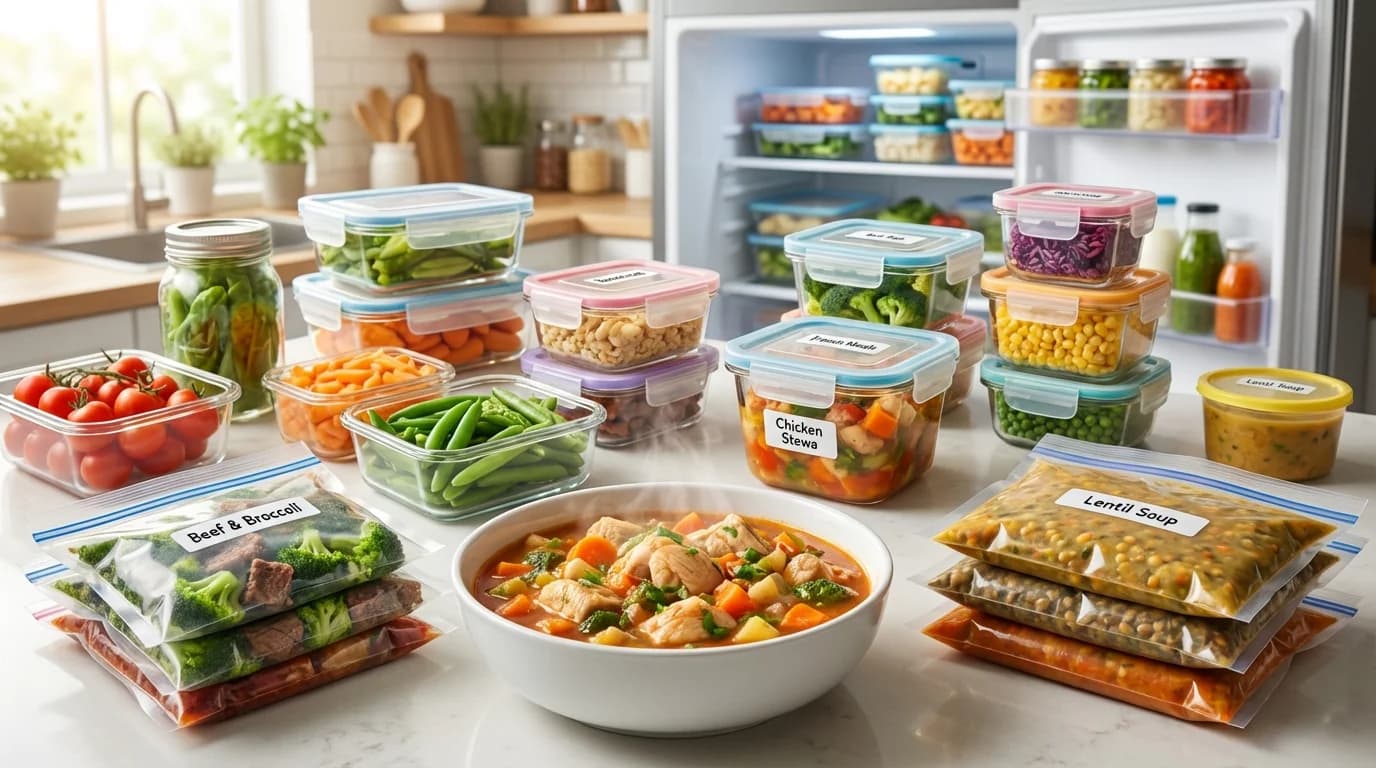
The difference between Sunday meal prep and freezer meal prep is time horizon. Sunday prep gets you through this week. A stocked freezer gets you through every future week.
Key Takeaways
- Double a recipe once a week and freeze half — that's how you build a freezer in 6 weeks without a marathon cooking day
- Some dishes (chili, braised meats, lasagna) genuinely taste better the next day or after freezing and reheating
- Always pull tomorrow's meal to the fridge tonight for overnight thaw — best texture every time
- Label every freezer item with name, date, servings, and reheat instructions
- Soups, stews, casseroles, and marinated raw proteins freeze beautifully; cream sauces, cooked rice in sauce, and fried food don't
The two systems work together: every Sunday you batch cook, and once a week you double one recipe and freeze half. After six weeks, you have a freezer stash that covers sick days, late work nights, surprise visitors, and the weeks when Sunday cooking just doesn't happen.
This guide covers both strategies: the science and recipes behind make-ahead meals (why some dishes genuinely improve overnight), and the freezer meal prep system for building a long-term safety net.
Why Some Dishes Taste Better the Next Day
It's not your imagination. Certain foods genuinely improve after sitting overnight or after a freeze-and-reheat cycle. Three things happen when food rests:
Salt and acid penetrate the protein. In a freshly made chili, the salt and spices sit mostly on the surface of the beans and meat. After 12-24 hours in the fridge, they diffuse throughout. The result: deeper, more integrated flavor.
Starches relax and release flavor compounds. Tomato sauce, curry, and stew rebuild around their seasonings as starch granules absorb liquid and soften. The sauce becomes more cohesive.
Volatile aromatics mellow. The sharp edge of raw garlic, the harsh note of ground cumin, and the bite of fresh onion all soften as they oxidize and integrate. The dish becomes rounder.
Anyone who's compared day-1 chili to day-2 chili already knows this intuitively. The science just confirms it.
The freeze-thaw effect: Freezing and thawing can actually improve certain braised dishes further. Ice crystals form during freezing, which breaks down cell walls slightly. On reheating, the sauce penetrates even more deeply into meat and vegetables. This is why leftover pot roast reheated from frozen often tastes richer than the original.
What Makes a Good Make-Ahead and Freezer Meal
Not every dish benefits from time. The dishes that improve are characterized by:
- High liquid or fat content (stews, braises, sauces)
- Complex spice blends that need time to integrate
- Proteins that benefit from extended salt contact (beans, braised meats)
- Dishes that were designed to be reheated (casseroles, soups)
The dishes that don't benefit — or actively get worse — have different characteristics: crispy textures that go limp, delicate proteins that over-cook on reheating, dairy-heavy cream sauces that separate, or leafy elements that wilt.
What NOT to Make Ahead or Freeze
Don't make ahead:
- Fried foods (lose crunch completely within hours)
- Leafy salads dressed in vinaigrette (wilt within 2 hours)
- Raw seafood dishes (off-flavors form quickly)
- Egg dishes that aren't custards or baked (rubbery when reheated)
- Any dish with avocado (oxidizes to grey-brown)
- Crunchy toppings (breadcrumbs, croutons, toasted nuts) — always add fresh
Don't freeze:
- Cream-based sauces (separate and grain on reheating)
- Cooked rice mixed into saucy dishes (turns mushy — freeze rice plain, separately)
- Mayo-based salads (egg salad, potato salad — ruined)
- Raw lettuce and most fresh vegetables
- Soft cheeses solo (cottage cheese, ricotta — acceptable only if mixed into a baked casserole)
- Hard-boiled eggs (rubbery)
- Plain Greek yogurt or sour cream (separates)
- Fried foods
40 Make-Ahead and Freezer Meal Recipes
Soups, Stews, and Chilis (10) — The Best Category
These are the highest-ROI make-ahead meals. They improve overnight, freeze beautifully, and reheat in minutes.
- Beef chili — peaks at 24-36 hours; freezes 4 months
- White chicken chili — tastes better next day; freezes 3 months
- Tortilla soup — bright and acidic, deeper flavors after resting
- Minestrone — the vegetables continue to flavor the broth overnight
- Italian wedding soup — better after 24 hours in the fridge
- Lentil curry stew — the spices fully integrate by day 2
- Chicken and wild rice soup — freeze without the rice; add fresh on reheat
- Beef stew — pot roast logic; genuinely better frozen and reheated
- Black bean soup — black beans absorb flavor deeply overnight
- Roasted tomato soup — fire-roasted version gets sweeter and deeper after resting
Casseroles (8)
- Lasagna — assemble Saturday night, bake Sunday. Or assemble and freeze unbaked. Bake from frozen at 375°F, covered 60 min + 15 min uncovered.
- Baked ziti — same logic as lasagna; freeze before baking for best texture
- Chicken enchiladas — use flour tortillas; corn tortillas get soggy in the fridge
- King ranch chicken — one of the best make-ahead casseroles; improves overnight
- Shepherd's pie — assemble and freeze unbaked; mash on top bakes fresh and fluffy
- Mac and cheese — use evaporated milk, not heavy cream; cream-based sauces freeze poorly
- Breakfast casserole — eggs + sausage + hashbrown base; assemble night before, bake morning
- Tuna noodle casserole — the classic make-ahead comfort food; undercook pasta before assembly
Braised and Slow-Cooked Proteins (6) — Tastes Better After Resting
- Pulled pork — eat on day 1, the rest improves significantly by day 2-3
- Beef brisket — nearly always better sliced cold and reheated the next day in its braising liquid
- Pot roast — the connective tissue continues to break down as it rests in the braising liquid
- Slow-cooker carnitas — freeze in 1-cup portions; reheat in a dry skillet to re-crisp
- Coq au vin — classic French braise designed to be made a day ahead
- Short ribs — fat re-distributes as they cool; always better day 2
Marinated Raw Proteins for the Freezer (4)
- Honey-garlic chicken thighs — freeze in zip bag with marinade; thaw and cook fresh. They marinate as they thaw — bonus.
- Korean bulgogi beef — freeze in marinade; the longer rest (days, even) improves flavor
- Lemon-herb chicken — classic Mediterranean preparation; freezes 3 months
- Carnitas pork shoulder — freeze raw in marinade for slow cooker; cook from thawed
Overnight and Make-Ahead Breakfasts (4)
- Overnight oats — prep 5 jars Sunday; breakfast Mon-Fri handled. Lasts 5 days.
- Chia pudding — same logic; prep 5 jars, add fruit fresh each morning
- Strata / breakfast casserole — assemble the night before; the bread absorbs the egg custard overnight for better texture than same-day baking
- Breakfast burritos — wrap in foil, freeze 12 at once; microwave from frozen 2 minutes
Pasta Salads and Grain Dishes (4) — Better After a Rest
- Pasta salad — genuinely improves with 4-12 hours in dressing; make the day before
- Tabbouleh — the bulgur absorbs the lemon-herb dressing overnight; always make ahead
- Vinegar-based coleslaw — cabbage softens and sweetens in the acidic dressing over 24 hours
- Tortellini salad — the tortellini absorbs the dressing for better flavor; make 1 day ahead
Sauces and Stocks (6)
- Marinara — 3-5 days fridge, 6 months freezer; always make a double batch
- Bolognese — the most universally better-next-day sauce; the meat integrates fully by day 2
- Chimichurri — bright herb sauce; mellow but still vibrant after 24 hours
- Chicken stock — make from bones left over from Sunday's roast chicken; freeze in 2-cup portions
How Far Ahead Can You Make Each Type?
| Dish type | Make-ahead window (fridge) | Freezer life |
|---|---|---|
| Soups, chili, stew | 1-3 days | 3-4 months |
| Casseroles (unbaked) | 1-2 days | 3 months |
| Casseroles (baked) | 3-4 days | 2-3 months |
| Marinated raw meat | 1-2 days | 3 months |
| Slow-cooked / braised meat | 3-4 days | 3 months |
| Overnight oats / chia | 4-5 days | Not recommended |
| Pasta salads | 1-3 days | Not recommended |
| Sauces | 5-7 days | 4-6 months |
| Chicken or beef stock | 4-5 days | 6 months |
| Burritos, hand pies | 3-4 days | 3 months |
| Banana bread, muffins | 3-4 days | 2-3 months |
The 6-Week Freezer Build (Without a "Freezer Day")
Old-school freezer cooking told you to spend an entire Saturday making 30 meals. That's exhausting, wasteful, and the reason most people only do a "freezer day" once before giving up.
The modern approach: double one recipe per week. After 6 weeks, you have 20-25 freezer meals without ever spending more than a normal Sunday cook session.
Week 1: Double the chili. Freeze 4-6 servings. Week 2: Double a marinara or baked ziti. Freeze a 9x13 pan. Week 3: Make 12 mini meatloaves. Eat 4, freeze 8. Week 4: Slow-cook 8 lbs pulled pork. Eat half this week, freeze half in 2-cup portions. Week 5: Make 12 breakfast burritos. Eat 4, freeze 8. Week 6: Big-batch lentil curry stew. Freeze 6 portions.
After 6 weeks: approximately 25 freezer meals. After 3 months: you're a household with a freezer that does its job. The cost is zero extra time — you're cooking the same things you'd cook anyway, just doubling the batch.
This pairs naturally with the Sunday meal prep 2-hour system. The Sunday cook becomes: cook 3 recipes as usual, but double one of them and freeze half.
Containers and Bags for Freezer Meal Prep
For soups, stews, and chili: Wide-mouth quart mason jars (leave 1 inch headspace) OR heavy-duty silicone bags (Stasher, Zip Top) laid flat. Silicone bags are superior for space efficiency — once frozen, they stack like books.
For casseroles: Disposable foil 9x13 pans are the most practical. No fighting to extract frozen food from a glass dish. Cover with foil, then wrap in plastic wrap, then label the plastic wrap. Double wrapping prevents freezer burn.
For meatballs and individual portions: Flash-freeze on a parchment-lined sheet pan (30 minutes spread in a single layer), then transfer to a bag. They won't clump together. Works for any individually portioned item: breakfast burritos, cookie dough balls, burger patties, muffins.
For marinated raw proteins: Heavy-duty zip-top or silicone freezer bags. Press out all air before sealing. Lay flat to freeze, then stand upright for long-term storage.
What to avoid: Thin plastic deli containers (crack in the freezer), glass containers that aren't specifically rated as freezer-safe (cheap glass cracks from expansion), any container without an airtight seal.
The Labeling Rule
Every single freezer item needs:
- Name of the dish
- Date frozen
- Number of servings
- Reheat instructions ("350°F, 25 min covered" or "stovetop low, 15 min")
Painters tape + Sharpie is sufficient. Write before filling so the label stays readable. Pre-printed labels and stickers fall off in the freezer — don't bother.
An unlabeled freezer is a freezer you don't use. Mystery frozen things stay frozen until someone throws them out.
How to Thaw: Best to Worst Methods
Best: Overnight fridge thaw. Pull tomorrow's meal to the fridge tonight. Slow, even thaw = best texture. Cooked proteins stay moist. Casseroles thaw uniformly. This is the method to default to whenever you have 12+ hours.
Acceptable: Cold water bath. Submerge sealed container in cold water. Change water every 30 minutes. 30-45 minutes for a quart of soup, 1-1.5 hours for a casserole. Fine for most dishes.
Acceptable with caveats: Microwave defrost. Works well for soups and single-portion dishes. Not recommended for casseroles (uneven thawing, some parts cook while others are still frozen).
Acceptable for soups: Cook from frozen. Frozen soup straight into a pot on low heat. Cover. 45-60 minutes, stirring occasionally as it melts. Add a splash of water if it seems too thick.
Never: Room temperature thawing. Food enters the temperature danger zone (40°F-140°F) and bacteria multiply rapidly. Not worth the risk.
Refreshing Make-Ahead and Frozen Meals
Even the best make-ahead meal benefits from a finishing touch at serving time. 30 seconds of effort at the plate changes day-3 food from "fine" to "actually good."
A squeeze of citrus brightens the whole bowl — lemon on Mediterranean dishes, lime on Tex-Mex, yuzu or orange on Asian flavors.
Fresh herbs on top. Parsley, cilantro, basil, chives. They don't survive reheating but they restore freshness to a reheated bowl instantly.
A spoon of yogurt or sour cream. Adds texture contrast and a cooling element against the heat of the reheated dish.
Toasted nuts or seeds. Toast a small batch on Sunday for the week (5 minutes in a dry pan). Adds crunch back to any dish that's been in the fridge.
Cracked black pepper. More than it sounds — freshly cracked pepper has volatile compounds that degrade in cooked food but survive fresh grinding.
A drizzle of really good olive oil. On Mediterranean dishes especially, a finish of high-quality olive oil (not the cooking oil) elevates everything.
These six moves are the difference between meals you look forward to and meals you eat out of obligation.
A Make-Ahead Sunday Plan for a Family of 4
Three hours of cooking on the weekend produces 4 weeknight dinners, mostly hands-off.
Saturday evening (10 minutes): Layer lasagna in a 9x13 dish. Refrigerate overnight. The pasta absorbs the sauce and bakes better for it.
Sunday morning (30 minutes): Slow-cooker carnitas in before 10 a.m. (cooks 8 hours on low). Start tomato basil soup on the stovetop — 30 minutes, walk away.
Sunday afternoon (30 minutes): Marinate chicken thighs (lemon-oregano) for Thursday. Bake the lasagna for tonight (45 minutes while you do other things).
The week:
- Monday: Lasagna leftovers (3 minutes to reheat)
- Tuesday: Carnitas tacos with avocado and quick-pickled onion
- Wednesday: Tomato basil soup with grilled cheese
- Thursday: Sheet-pan lemon-oregano chicken + roasted potatoes + vinegar slaw
Total active cooking time for the week: approximately 75 minutes spread across Saturday and Sunday. Every weeknight is a pull-and-heat or a simple 25-minute sheet-pan dinner.
The Sample "Freezer Pull" Week
This is what the freezer stash is built for — the weeks when real life intervenes and Sunday cooking doesn't happen.
- Monday: Pull lasagna to fridge to thaw
- Tuesday: Bake lasagna (mostly hands-off, 60 minutes)
- Wednesday: Pull chili, eat with fresh cornbread (store-bought mix is fine)
- Thursday: Mini meatloaves from freezer + microwaved sweet potato
- Friday: Frozen breakfast burritos + scrambled eggs
Total active cooking across the week: approximately 30 minutes. The freezer stash absorbs the week entirely.
Connecting to the Bigger System
Freezer meal prep works best as part of a broader weekly rhythm. The Sunday meal prep guide covers the 2-hour weekly cook session. The batch cooking app helps you plan which recipes to double for the freezer. The shopping list tool generates the grocery list from your planned meals — including the extra portions you're freezing.
For budget-focused families, the budget efficiency of freezer cooking is significant: buying in bulk when proteins are on sale (chicken thighs at $1.49/lb, ground beef at $3.99/lb) and batch-cooking into freezer portions saves 15-20% versus weekly fresh purchases. See budget meal prep for beginners for the full cost breakdown.
How Long Does Everything Last?
| Item | Best quality by |
|---|---|
| Cooked soups, stews, chili | 3-4 months |
| Casseroles (cooked or uncooked) | 2-3 months |
| Meatballs, meatloaf | 3 months |
| Marinated raw proteins | 3 months |
| Cooked grains (plain) | 3 months |
| Breakfast burritos | 3 months |
| Braised and pulled meats | 3 months |
| Bread, muffins, quick breads | 2-3 months |
| Sauces | 4-6 months |
| Stock and broth | 6 months |
After these windows, food is still safe (if held continuously at 0°F) but texture and flavor degrade noticeably. Date-labeling every item is what makes rotation possible.
FAQ
How long does freezer meal prep last? 3-4 months at 0°F or below for most cooked items. Sauces and stocks last 4-6 months. After that, food is still safe but quality drops. Mark dates on everything.
Can I freeze meals in glass? Yes, but use freezer-safe glass specifically (Pyrex and Glasslock state this on packaging). Leave 1 inch of headspace for liquid expansion. Cheap unbranded glass cracks. Wide-mouth mason jars work well for soups — freeze upright with the lid slightly loose until frozen solid, then seal completely.
Can I freeze cooked rice or pasta? Plain cooked rice and pasta freeze fine in 1-cup portions. Avoid freezing them mixed into saucy dishes — the starch absorbs too much liquid and turns mushy. Add freshly cooked rice or pasta when reheating.
What's the easiest make-ahead meal for beginners? Beef chili. Make on Saturday, eat Sunday or Monday. Freeze the rest. Gets better with every hour in the fridge. Hard to mess up, requires no special technique.
Should I freeze raw or cooked proteins? Both work. Raw marinated proteins are fastest to plate (cook fresh after thawing). Cooked stews and casseroles are fastest to reheat. A mix of both is ideal — cooked soups and casseroles for the weeks when you don't want to cook at all, raw marinated proteins for fresh-cooked nights when you have 20 minutes.
How do I avoid freezer burn? Squeeze all air out of bags before sealing. Double-wrap casseroles (foil + plastic wrap). Use the freezer's coldest area (usually the back bottom). Rotate using date labels so old items come out before new ones go in.
Can I make ahead meals for a dinner party? Yes — anything braised, all soups and sauces, and dough can be prepped 1-3 days ahead. Save fresh elements (salads, dressings, garnishes, anything fried) for day-of. Braised short ribs made 2 days ahead and reheated in their braising liquid are genuinely better than same-day.
Track Your Freezer Inventory in MyRecipe
Open a "Freezer Inventory" collection in MyRecipe. Each time you freeze a portion, add a quick note: dish name + date. When you pull something out, remove the note. You'll always know what's in there and how old it is. Browse the recipe library for community-tested freezer-friendly recipes, or sign up free to start tracking your own stash.
About myrecipe
myrecipe helps families save, organize, and share their favorite recipes in one place. Plan meals, create shopping lists, and preserve your culinary traditions.
Start Organizing Recipes