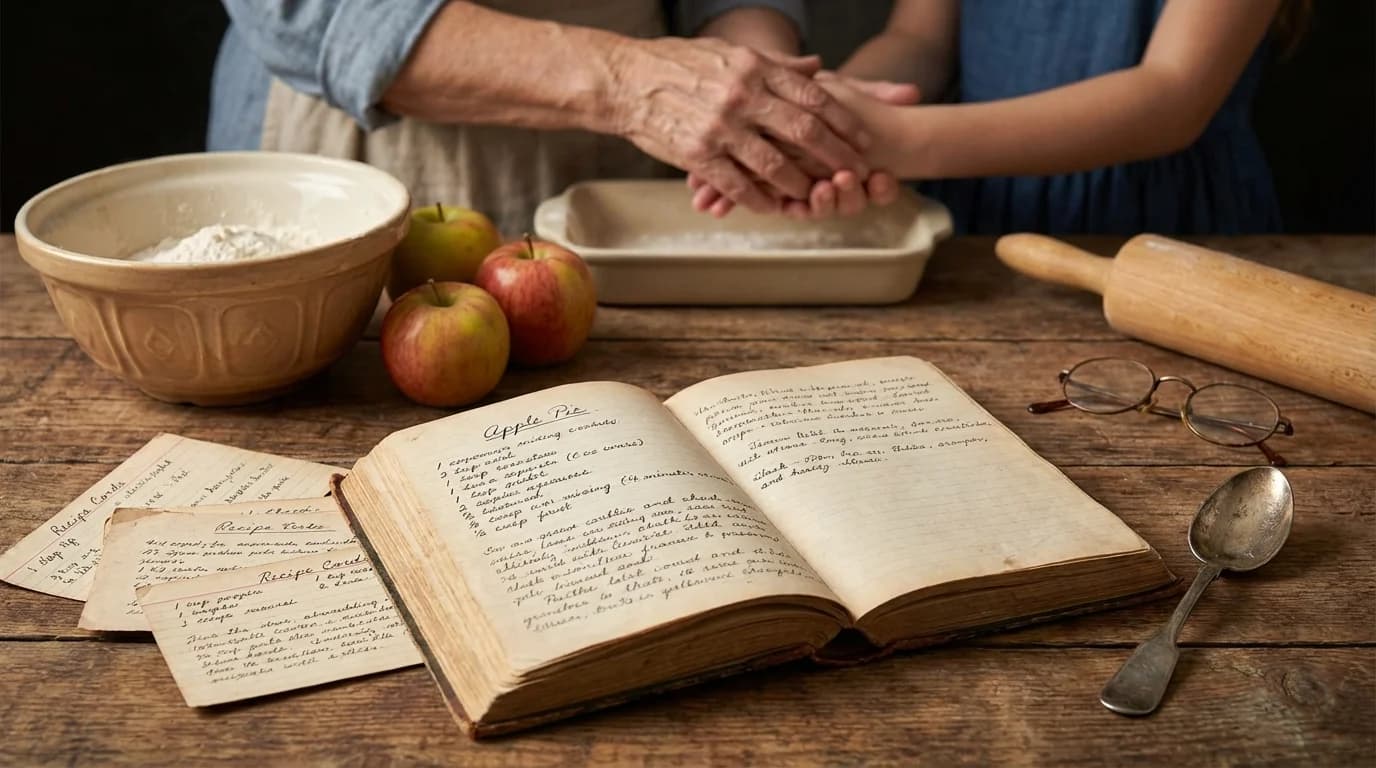
Last Thanksgiving, I watched my 82-year-old grandmother make her famous apple pie — the same one she's been baking for over 60 years. As I watched her work, something hit me: she never measured anything. A handful of this, a pinch of that, "until it feels right."
Key Takeaways
- The best time to start preserving grandma's recipes is while she can still tell you what the card doesn't say
- Scanning handwritten recipe cards takes under a minute per card with modern OCR tools
- The stories behind the recipes matter as much as the recipes themselves
- A digital family cookbook means the recipes never get lost in a move, a flood, or an estate sale
When she's gone, this recipe might be gone too. Not because she wouldn't share it, but because it exists entirely in her hands, her intuition, her lifetime of experience.
If you have a grandmother, grandfather, parent, or older relative who cooks, the time to preserve their recipes is now. Not next year, not when you have more time — now. This guide shows you exactly how to capture not just their recipes, but the techniques, stories, and variations that make their cooking irreplaceable.
Why Grandma's Recipes Are Disappearing
Every year, thousands of families lose irreplaceable recipes. Not because the recipes are bad or forgotten — but because:
- Recipe cards are stored in shoeboxes that never survive a move intact
- The card says "a pinch of salt" but the cook knows it means "about a teaspoon"
- Handwriting fades, paper yellows, butter stains obscure ingredients
- The cook passes away and the knowledge goes with them
The digital generation has other problems too. Screenshots in camera rolls get buried or deleted. Pinterest pins go dead when food bloggers close their sites. URLs break. Apps get shut down.
The only reliable preservation is a dedicated, backed-up digital recipe library — one that stores not just the text of the recipe but the photos of the original cards, the family notes, and the stories that give the recipes their meaning.
Step 1: Start with a Conversation
If your grandmother is still alive and still cooking, your most important first step is a conversation — not a scanning session.
Sit down with her (or video call if you're far away) and ask:
"What are the five recipes you're most proud of?"
Write down the answers. Then, for each one:
- Ask her to walk you through the recipe out loud
- Note anything she says that isn't on the written card
- Ask about the origins: "Where did you learn this?" "Who taught you?" "Is this from your mother's family?"
- Ask about variations: "What do you do differently in summer?" "What do you substitute when you're out of X?"
These conversations are where the irreplaceable parts of family recipes live. The card says ½ teaspoon of cardamom. The conversation tells you she learned it from her own grandmother in Poland who used to add it to everything, and that's why the smell of cardamom reminds the whole family of her kitchen.
Write these things down. Add them as notes in the recipe. They are as valuable as the ingredient list.
Step 2: Collect All the Physical Recipes
Before you start digitizing, gather everything that exists. This means:
- Index cards in recipe boxes (often organized by category or not organized at all)
- Notebooks with handwritten recipes
- Clippings from magazines or newspapers
- Recipes on the backs of product labels saved because the recipe was so good
- Recipes in her handwriting inserted into printed cookbooks
- Recipe cards written by her mother or grandmother — generational family recipes
Don't assume anything is trash. The faded scrap of paper tucked into the cookbook spine might be the most important recipe in the collection. Set everything out on a clean table and sort before you scan.
Pro tip: Before sorting, take a wide photo of everything laid out. This "before" image often becomes one of the most meaningful photos in the family's collection — a visible record of a life spent cooking.
Step 3: Scan Every Card (This Takes Less Than You Think)
Scanning handwritten recipe cards sounds like a big project. It isn't. With MyRecipe's built-in OCR scanner, you can scan a 4x6 index card in about 30 seconds:
- Open the app
- Tap the scan/import button
- Point your phone camera at the card
- The OCR reads the handwriting into structured text (title, ingredients, instructions)
- Review the result, fix anything the scanner missed
- Save with the original photo attached
Most users scan 60-100 cards in a single afternoon. What feels like an overwhelming project becomes a finite, completable task.
What the OCR Does Well
The scanner is specifically trained for recipe card formats:
- Ingredient lists with measurements
- Numbered instruction steps
- Mixed cursive and print
- Faded ink with adequate lighting
What It Struggles With
- Recipes smeared with batter or oil (scan what you can, type the rest)
- Very faded ink in poor lighting (try a flashlight from the side, or scan outdoors in natural light)
- Multiple recipes on one card (scan and then split into separate recipes in the editor)
After scanning, the original card photo stays permanently attached to the digital recipe. You keep both the sentimental original and the searchable text — which is exactly right. The point isn't to replace the card; it's to back it up.
Step 4: Capture the Techniques That Aren't Written Down
Recipe cards capture ingredients and steps. They don't capture:
- Why you add the butter at that exact moment
- What "done" looks and smells like (before the timer says it is)
- The variation that works better in humid weather
- The substitution that makes it dairy-free for guests without changing the flavor
These techniques live in the hands and nose and memory of the cook — not in the card. There are two ways to capture them.
Cook With Her
If grandma is still able to cook, make her recipes together. Bring your phone. Record short video clips of the key moments: the moment she "just knows" the oil is hot enough, the way she folds the dough, the little pause before she adds extra seasoning.
These videos don't need to be professional. A shaky 30-second phone clip of her hands rolling dough is irreplaceable. You can add the video as an attachment to the recipe in your digital library.
Interview Her After Cooking
After a cooking session, ask follow-up questions:
- "You added the garlic later than the recipe says — why?"
- "You used less sugar than it calls for — is that what you always do?"
- "What do you do when you don't have [ingredient]?"
Write the answers as recipe notes. "Grandma always adds the garlic in the last five minutes so it doesn't burn." "She uses less sugar — said the original card was her mother's and her mother had a sweeter tooth." These notes become the oral history of the recipe.
Step 5: Organize the Collection
A preserved recipe collection is only useful if you can find what you're looking for. Once recipes are digitized, spend 30 minutes organizing:
Tag by Occasion and Origin
Create custom tags that make sense for your family:
- "Grandma Ruth's" — everything from your maternal grandmother
- "Grandma Lily's" — everything from your paternal grandmother
- "Christmas" — dishes always made at the holidays
- "Sunday Dinner" — the weekly staples
- "Heirloom" — recipes passed down more than two generations
In MyRecipe's recipe organizer, you can tag any recipe with multiple custom tags and filter to any combination. "Christmas + Grandma Ruth's" shows you exactly which holiday recipes she passed down.
Create a Family Cookbook Collection
Group all the family heirloom recipes into a collection called "Family Cookbook" or "Grandma's Kitchen" or whatever name fits. This collection is the digital equivalent of the printed family cookbooks families used to make for reunions — except it's searchable, shareable, and never goes out of print.
Add the Context
For each recipe, add a brief description with the family backstory:
- Who taught this recipe and from whom they learned it
- When it's traditionally made
- Any family members associated with this dish (the niece who always requests it, the uncle who makes it differently)
- Year the recipe originated if known
These descriptions are what make a recipe collection a family archive rather than just a list of ingredients.
Step 6: Share the Collection With the Family
A preserved collection that lives only on your phone helps only you. The whole family should have access.
Share Individual Recipes
For any recipe you want to share immediately, set it to "link only" in MyRecipe and send the URL. Anyone with the link can view the recipe — ingredients, steps, notes, and the original card photo — without creating an account.
This is perfect for:
- Sending Aunt Karen's pierogi recipe to the cousin who asked
- Sharing grandma's apple pie recipe with the grandchildren before Thanksgiving
- Sending the whole holiday baking collection before Christmas
Invite Family to a Shared Library
On MyRecipe's Family plan, you can invite up to four household members to share the same recipe library. For extended family, individual recipes and collections can be shared via link.
Consider designating one family member as the "keeper" of the digital family cookbook — the person who adds new recipes as they're discovered, keeps the tags organized, and makes sure the collection stays current. This person is doing something genuinely important for the family's cultural heritage.
Build a Printable Family Cookbook
For milestones — a family reunion, a grandmother's 90th birthday, a memorial after she passes — export the collection as a printed cookbook. MyRecipe allows PDF export of any collection, which you can take to a print-on-demand service for a bound, physical cookbook.
A printed family cookbook makes a gift that any family member would treasure. It's also a redundant backup — digital and physical together mean the collection survives almost anything.
Step 7: The Recipes That Exist Only in Memory
Not everything is written down. Some dishes exist purely in muscle memory — grandma doesn't use a recipe because she never needed one. Here's how to capture these:
The 30-minute recording session. Ask her to narrate her most-made recipe start to finish while you record it on your phone. She talks, you type (or transcribe later). Then ask clarifying questions: "You said 'some flour' — how much do you think?" "When you say the meat should be brown, what shade?" This session captures the dish even if no written card exists.
The make-together-and-write-down session. Cook the dish together. Your job: write down everything she does and every quantity you can measure. "She added oil — measured it after: roughly 3 tablespoons." This is the most accurate method for dishes made entirely by feel.
Accept that some recipes can't be fully captured. A recipe that depends on 60 years of sensory memory and muscle memory won't be 100% reproducible from a written recipe. That's okay. Capture what you can. The written version will produce something close, and over time, your family will cook it enough times to develop their own intuitions.
A Recipe Worth Walking Through: Grandma's Apple Pie
To make this concrete, here's what the preservation process looks like for a specific recipe.
What was on the index card: Grandma's Apple Pie. 6 apples, peeled and sliced. 3/4 cup sugar. 1 tsp cinnamon. 1/4 tsp nutmeg. Pie crust (2). Bake 375 for 45 minutes.
What the conversation added:
- "Use tart apples — Granny Smith mostly, sometimes half-and-half with Honeycrisp"
- "The sugar varies — if the apples are very sweet, use less. If it's Granny Smith, I go closer to a full cup"
- "Add a tablespoon of butter on top of the filling before you put the top crust on — she learned this from her mother, it makes the filling glossy and rich"
- "She always cuts a pattern into the top crust. The pattern changes. It was hearts when she was young, now it's just slits."
- "45 minutes at 375 — but you know it's done when you can hear the filling bubbling through the crust"
What the notes record: "This recipe came from great-great-grandmother Esther, who brought it from Poland in the 1920s. Originally made with whatever apples were available from the backyard tree. Grandma makes this every Thanksgiving and Christmas. The whole house smells like cinnamon for two days. She learned it standing on a step stool next to her own grandmother when she was five years old."
That's a preserved recipe. The card has the ingredients. The conversation has the technique. The notes have the story. Now it's safe, searchable, and shareable — and when your own children make this pie someday, they'll have everything they need.
When You're Preserving After a Loss
If you're reading this after a grandmother or parent has passed away — first, I'm sorry. This is a hard project to take on in a time of grief, but it's one that many families find meaningful and healing.
A few practical notes for this situation:
Start with what you have. Sort through any recipe boxes, notebooks, or loose recipe cards that are part of the estate. Photograph everything before it gets distributed or discarded.
Ask other family members what they remember. Aunts, uncles, cousins, and older family friends may remember the recipe from having eaten it or watched it being made. Their recollections fill in the gaps the cards leave.
Cook from the cards. As you cook each recipe, make notes. "The card said 'season to taste' — I used about 1 tsp salt and 1/2 tsp pepper and it was exactly right." These cooking notes become the next generation's version of the oral instruction that was lost.
Use it as a memorial project. A family cookbook assembled in the months after a loss is one of the most meaningful memorial gifts a family can give each other. It's a way of keeping the cook's presence alive in the kitchen.
Where to Keep the Preserved Recipes
Whatever you do, don't leave the preserved recipes in:
- A single folder on one person's phone
- A notes app without backup
- A service that might shut down or lock your data
Use MyRecipe for recipe preservation because:
- Every recipe is cloud-backed and synced across devices automatically
- You can export your entire library at any time — your recipes are never locked in
- The original card photos are attached and stored alongside the text
- Recipes can be shared individually or as collections with any family member
- The Family plan lets up to four household members co-maintain the same library
The goal is a preserved collection that will outlast any single device, service, or family member's phone. Redundancy — cloud backup plus PDF export plus shared access across family — is how you guarantee that grandma's apple pie recipe is still findable in 2050.
Getting Started Today
You don't need to scan the whole box today. Start with five recipes — the five your family makes most, or the five grandma is most proud of. Scan those first.
Then do five more. And five more.
By the third session, you'll have a meaningful family recipe archive, and the project will feel manageable rather than overwhelming.
Resources to get started:
- Digitize handwritten recipes with MyRecipe's OCR scanner
- Build a digital family cookbook
- How to create a family cookbook as a gift
- Convert handwritten recipes to digital format
- Digitize your entire family recipe collection
The recipes that exist in your grandmother's hands are yours to lose. Or yours to preserve. The scanning session takes an afternoon. The recipe archive lasts forever.
About myrecipe
myrecipe helps families save, organize, and share their favorite recipes in one place. Plan meals, create shopping lists, and preserve your culinary traditions.
Start Organizing Recipes