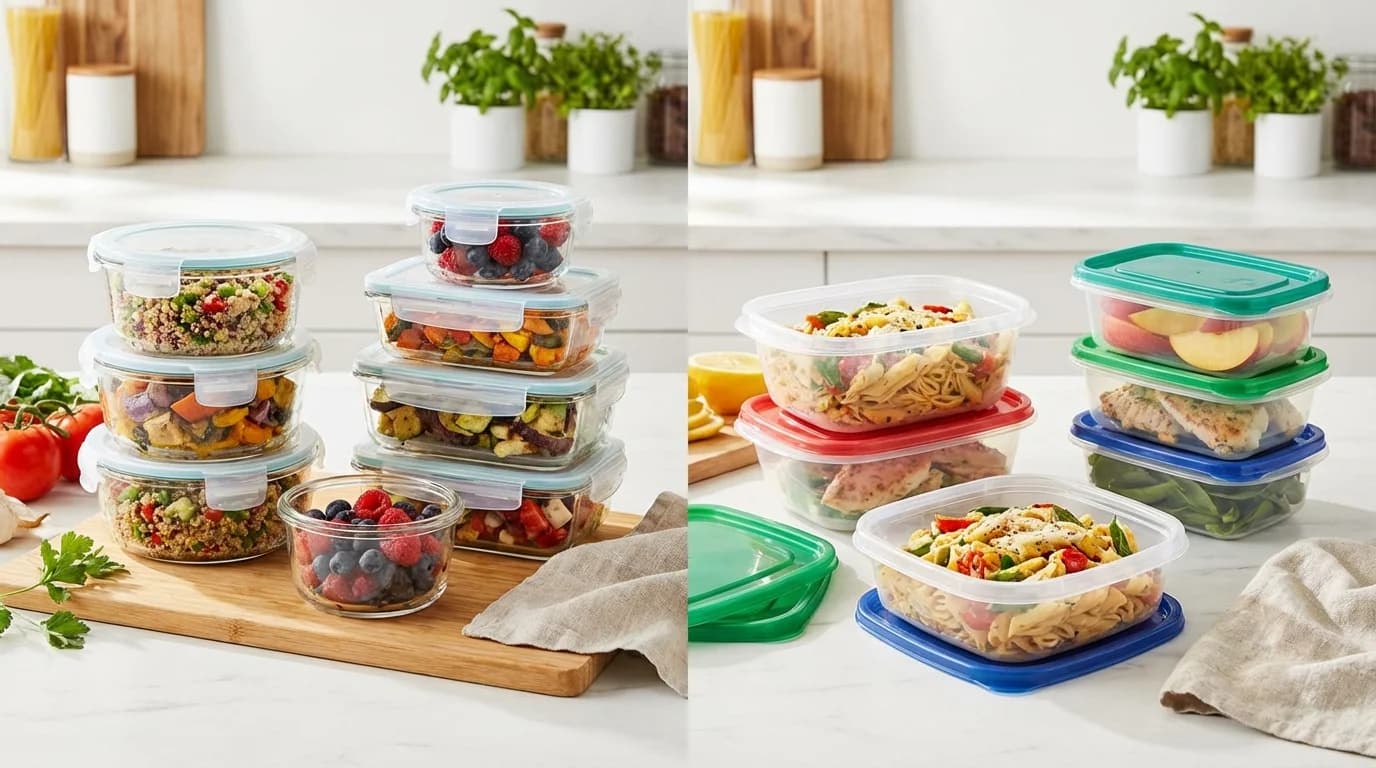
Most guides to meal prep containers start with product recommendations. This one starts with the workflow — because a great container in the wrong system is just clutter, and a mediocre container used correctly lasts years.
Key Takeaways
- Your container system should serve your workflow, not the other way around
- Glass for meals you'll reheat; plastic or silicone for cold storage, snacks, and freezer
- You need 8-10 containers in 3 sizes (2-cup, 4-cup, 6-cup) — not 30
- Labeling is not optional — name, date, servings, and reheat instructions on every container
- Stacking efficiency in fridge and freezer is a planning decision, not a storage accident
Here's what the right container system actually looks like: on Sunday you batch-cook, portion into containers that stack cleanly, label every one clearly, and store them so Monday-through-Thursday retrieval is one motion — open fridge, grab container, heat. That's the whole system. The containers are in service of that outcome.
This guide covers what to buy (and what not to), how containers integrate into batch cooking workflow, labeling systems that actually stick, freezer stacking, and the 8-piece starter set that handles 90% of real meal prep.
The Workflow Comes First
Before buying anything, answer three questions:
1. Are you eating at home or taking food to work? At home: glass containers are ideal. They reheat better, don't stain, and last years. At work in a bag: plastic or compartment containers are more practical because they're lighter and you're less likely to break them in transit.
2. What are you primarily storing? Complete meals (protein + grain + veg): 4-cup and 6-cup containers. Sauces and dressings: mason jars. Snacks and pre-portioned breakfasts: 2-cup containers and small jars. Freezer batches: silicone bags, disposable foil pans, or wide-mouth quart jars.
3. How many days of food are you prepping? One person, 5 days: you need 10-12 containers. Family of 4, 4 dinner nights: you need 4 large containers plus serving dishes. Scale from there.
Most people over-buy containers because they approach it as "more is better." In practice, a focused set of 8-10 quality containers beats a 30-piece mixed set with mismatched lids and varying quality by a wide margin.
Glass vs. Plastic: The Real Comparison
| Criteria | Glass | Plastic (BPA-free) |
|---|---|---|
| Repeated reheating quality | Excellent | Degrades over time |
| Staining from tomato/curry | Doesn't stain | Stains reliably |
| Plastic taste transfer | None | Some, especially post-dishwasher |
| Weight | Heavy (downside for transit) | Light |
| Drop survival | Breaks | Fine |
| Freezer use | Yes (freezer-safe glass only) | Yes |
| Oven compatibility | Yes (without plastic lid) | No |
| Lid seal quality | Snap-tight is excellent | Often slightly better leakproof |
| Cost upfront | Higher ($6-15/container) | Lower ($2-5/container) |
| Realistic lifespan | 5-15 years | 1-3 years |
| Long-term cost | Lower | Higher (repeated replacement) |
The honest verdict: Glass is better for the primary meal containers you'll reheat at home. Plastic is practical for:
- Taking food to work in a bag (lighter, survives drops)
- Snack containers that don't get reheated
- Kid lunchboxes (they will drop it)
- Freezer bags (silicone or zip-top)
Most experienced meal preppers end up with a hybrid: glass for the main fridge meals, plastic or silicone for lunchboxes and freezer storage.
The Glass Containers Worth Buying
Pyrex with snap-tight lids The original standard. Oven-safe to 450°F without the lid. Snap-tight lids don't leak with rice or stews in normal carrying. Dishwasher safe — lid goes top rack, glass bottom goes anywhere. Widely available, replacement lids sold separately. This is the default recommendation.
Glasslock The best leakproof seal in glass. Uses a four-latch locking mechanism rather than snap corners. If you're carrying soups or sauces in a bag, Glasslock is worth the extra few dollars. Dishwasher safe, oven safe to 392°F without lid.
OXO Good Grips Smart Seal Pricier (roughly $15-20 per container). Sturdier than Pyrex. The seal is excellent, the glass is heavier-duty. Good if you're buying containers you expect to keep for 15+ years.
Ello Duraglass Same borosilicate glass as Pyrex, but wrapped in a silicone sleeve that protects against drops and provides a grip. Slightly lower profile for stacking. Better for households with kids handling the containers.
What to avoid in glass: Cheap unbranded sets from discount stores — the glass is thinner (more likely to crack from thermal shock), and the lids stop sealing within 6 months. Snapware made by third-party manufacturers (not the original Corelle Brands version): the latches tend to snap off.
The Plastic Containers Worth Buying
Rubbermaid Brilliance (BPA-free) The best plastic container available for fridge use. The lid has an interlocking latch system that creates a genuinely leakproof seal. The container itself is crystal-clear, so you can see contents without opening. Dishwasher safe, microwave safe (vent before use). The go-to recommendation for anyone who needs lightweight or portable containers.
Komax (BPA-free) Better price point than Rubbermaid Brilliance with similar seal quality. Microwave and dishwasher safe. Slightly less durable over years of dishwasher use, but excellent for 2-3 years of regular use.
Bentgo bento-style boxes Compartmented lunch containers for work or school. The dividers keep proteins away from vegetables and sauces separate. Particularly good for kids' lunches and for adults who prefer components served separately.
Stasher silicone bags The best replacement for disposable zip-top freezer bags. Reusable, dishwasher safe, freezer safe, and microwave safe (vent). Lay flat in the freezer to save space. Expensive upfront (approximately $15-20 per bag) but pay for themselves within a year against disposable alternatives.
What to avoid in plastic: Takeout container reuse — they're typically not food-safe for repeated microwave use and degrade quickly. Dollar store sets — not food-grade, not microwave safe, not worth the drawer space.
Container Sizes: The Three You Actually Need
Forget the 27-piece pyramid set. The three sizes that cover real meal prep:
2-cup (16 oz) One lunch-sized soup portion, a side dish, pre-portioned snacks, breakfast oatmeal, one serving of sauce. You need 2-3 of these.
4-cup (32 oz) The workhorse. A complete main meal: protein (5-6 oz) + grain (3/4 cup) + vegetable (1 cup). This is the size that covers 80% of batch-cooked meals. You need 5-7 of these.
6-cup (48 oz) Large dinners, family sides, big grain salads, multi-meal storage. You need 2-3 of these.
Plus: mason jars. Wide-mouth pint jars (2-cup capacity) are the cheapest, most versatile tool in meal prep. Sauces, dressings, overnight oats, salad jars, small side portions. A 12-pack costs approximately $10-12 and handles half of what specialty small containers would cover.
Sizes worth skipping for most people:
- 3-compartment containers (rigid thinking — just use multiple containers)
- 1-cup containers (mason jars do this better)
- 2-gallon stock containers (rare use, takes up significant space)
The 8-Piece Starter Set (With Estimated Costs)
If you're starting from zero:
- 5 × 4-cup glass containers with snap-tight lids (Pyrex or Glasslock) — approximately $30-40
- 2 × 2-cup glass containers (sauces, sides) — approximately $10-12
- 1 × 9x13 glass baking dish with lid (casseroles, large batches) — approximately $20-25
- 6 × wide-mouth pint mason jars with lids (sauces, overnight oats, salad jars) — approximately $10-12
- 5 × silicone bags (Stasher or Zip Top, for freezer) — approximately $25-35
Total: approximately $95-120. This set lasts 5-10 years with normal use. It handles one person's full week of batch cooking across all storage types.
For a family of 4, add: 4 more 4-cup containers and 3 more 6-cup containers. Total additional cost: approximately $40-50.
Labeling: The Step That Actually Determines Success
A drawer full of unlabeled containers by Wednesday is the single most common reason people abandon meal prep. "What is this?" defeats every other part of the system.
What every container needs:
- Name of the dish
- Date prepared
- Servings (or portions per container)
- Reheat instructions if non-obvious
Tools that work:
- Painters tape + Sharpie permanent marker: the classic system. Tape peels off cleanly from glass, leaves no residue. Write on the tape, not the container.
- Dry-erase marker on glass: writes well on glass, wipes off with a damp cloth. Works if you're consistent about wiping clean before reuse.
- Pre-printed labels: look nice, fall off when wet. Skip them.
- Masking tape: similar to painters tape but leaves more residue. Acceptable substitute.
Labeling for families: Add a color-coded dot sticker for who the container belongs to. Blue dot = adult portions, yellow dot = kid portions. Takes 5 seconds, eliminates "that's mine" negotiations at lunch.
Labeling for the freezer: Every frozen item gets date + name + reheat temp/time + servings. Use a Sharpie directly on the container or bag — freezer condensation destroys tape-based labels. Write before you fill.
Stacking: How to Store 10 Containers in a Reasonable Refrigerator
An organized fridge is a functional system. A fridge where containers are stacked at random angles and stuff falls out every time you open the door is a system that makes people not want to cook.
The stacking rules:
Match containers to make clean stacks. All 4-cup containers from the same brand stack flat. Mixing brands and sizes creates wobbly towers.
Short items (2-cup) go in front, tall items (6-cup) go in back. You should be able to see every container without moving anything.
Designate one shelf as the "current week" shelf. Everything from Sunday's cook lives here. When that shelf is empty, it's time to shop and prep again.
Mason jars live in the door or on a separate shelf from stacked containers. They're too round to stack reliably with square containers.
Fridge loading order after batch cooking:
- Let everything cool fully (lid-off, counter, 20-30 minutes).
- Label while cooling — this is the moment you have all the information in front of you.
- Load fridge with the latest-expiring items at the back, earliest-expiring in front. The item you'll eat Monday should be the first thing you grab.
Freezer Storage: Containers and Stacking Strategy
Freezer meal prep uses different containers than fridge meal prep, and the stacking logic is entirely different.
For soups, stews, chili: Wide-mouth quart mason jars (leave 1 inch headspace for expansion) or heavy-duty silicone bags laid flat. Silicone bags are superior for freezer space efficiency — once frozen, they stack like books.
For casseroles: Disposable foil 9x13 pans with foil covers are the most practical for large portions. No fighting to get frozen food out of a glass dish. Cover with foil, then wrap in plastic wrap, then label the plastic. The plastic wrap layer prevents freezer burn.
For meatballs, individual portions: Flash-freeze on a sheet pan first (20-30 minutes, spread in a single layer). Then transfer to a bag. They won't clump together. This trick works for any individually portioned items: muffins, breakfast burritos, cookie dough balls, burger patties.
For marinated raw proteins: Zip-top or silicone freezer bags work best. Press out all air before sealing. Lay flat to freeze, then stand upright for storage once frozen. These become your "cook from frozen" emergency dinners — pull to the fridge the night before, cook fresh.
Freezer temperature note: 0°F (−18°C) is the correct operating temperature for home freezers. At 5°F or above, the freezer is in the "danger zone" temperature range and food quality degrades significantly faster. If you're finding ice crystals forming on food within a few weeks, your freezer temperature is too variable.
Integrating Containers Into the Batch Cook Workflow
The best container systems become invisible — you stop thinking about them and they just work. Here's how the container decisions connect to the Sunday meal prep system:
Before cooking: Pull containers out the night before or first thing Sunday morning. Stage them on the counter. Seeing them empty creates a useful visual of what you're filling.
While cooking: When a recipe is done, it goes directly into the container (after 10-minute cooling). Don't let finished food sit in the pan while you're working on the next recipe — it continues cooking and dries out.
Portioning math: For the batch cooking approach, work out your portions before you start. 3 lbs chicken thighs makes approximately 10 × 5-oz portions, which is 10 main-meal servings. 4 cups dry rice makes approximately 12 cups cooked. Do this math first so you know how many containers of each size you need before you start cooking.
When you save a recipe in MyRecipe, add a note to the recipe: "Yields: 6 servings, fits 6 × 4-cup containers." Future-you will thank you on Sunday when you're figuring out container logistics for the week.
Kids and Family-Specific Container Considerations
Families with kids have different container requirements than solo meal preppers:
Shatterproof matters more. If a container will be in a school backpack, in small hands, or in a lunchbox that gets dropped, glass is a real risk. Bentgo, PlanetBox, and Yumbox are the better options for kids' school containers. Stainless steel lunchboxes (PlanetBox) are the most durable long-term and don't absorb odors.
Compartments matter for picky eaters. Many kids (and some adults) strongly prefer food that doesn't touch. Compartmented containers are not just cute — they're functional for households with texture-sensitive family members.
Leakproof matters more. A leaking container in a backpack ruins a school day. Prioritize latching or four-corner locking lids for anything leaving the house in a bag.
Portion size varies by age. A 4-cup adult container is too large for a 4-year-old. A 2-cup container + a small jar for sauce or snack is more appropriate. Having containers in genuinely different sizes matters for families.
For lunchbox content ideas, see lunchbox ideas for kids. For batch cooking portioning for a full family, the meal prep for family of 4 guide has quantity tables for different family sizes.
Container Care: Making Your Investment Last
Glass:
- Never put hot glass directly on a cold surface — thermal shock can crack it. Use a trivet or towel.
- Oven use is fine without the plastic lid. Never put a plastic lid in the oven.
- Hand wash lids with rubber gaskets. The dishwasher degrades gaskets faster than any other use. The glass itself is dishwasher safe.
- Air-dry lids face-down so water doesn't pool inside the gasket seal.
- Stain from tomato sauce: baking soda paste, leave 30 minutes, scrub. Or leave the container in direct sunlight for a few hours — UV bleaches out the orange tinge.
Plastic:
- Top rack of dishwasher only. Bottom rack heat warps most plastic containers.
- Don't microwave with the lid sealed — vent it first (snap corner open or remove entirely).
- Replace when any whitening, cracking, or warping occurs. Compromised plastic is both a food safety concern and a seal quality concern.
Silicone bags:
- Dishwasher safe on any rack.
- Stand upright after washing to let interior dry completely before storing (trapped moisture grows mold).
- Inspect the seal periodically — slit seals affect both freezer protection and carrying safety.
Common Container Mistakes That Undermine Your Meal Prep
Buying a 30-piece set. You'll use 8 containers and spend 6 months looking for the matching lid to the other 22. Quality over quantity is real here.
All one size. Three sizes is the minimum. If all you have are 4-cup containers, you can't separate sauces, can't store snack portions efficiently, and can't handle the 9x13 casserole that would feed the family three times.
Forgetting mason jars. They're the most underpriced, most versatile tool in meal prep. Sauces, dressings, overnight oats, salad jars, small portions of soup, dry ingredient storage — all handled by a $1.50 jar. If you have none, buy a 12-pack before anything else.
No lid organization system. Lids in a pile beneath containers lead to a drawer that looks like a cabinet avalanche. One simple solution: a small bin for lids, stacked by size. Or a second-drawer lid organizer. Five minutes to set up, saves 30 seconds every time you look for a lid.
Buying containers before deciding on the system. The system determines the containers, not vice versa. Decide if you're prepping for one person or a family, if food is eaten at home or transported, and if you're using a freezer rotation or not. Then buy the containers that serve those answers.
FAQ
Are glass meal prep containers worth the extra cost? For meals you'll reheat repeatedly at home, yes. They don't stain, they don't transfer plastic taste, and they last 5-15 years. For snack prep, freezer storage, and kids' lunchboxes, plastic or silicone is fine.
What size meal prep containers should I buy? Three sizes: 2-cup (sides, snacks), 4-cup (main meals), 6-cup (large dinners, salads, family portions). 5 × 4-cup is the most important purchase. Add from there based on your specific needs.
Can glass meal prep containers go in the freezer? Yes — but use freezer-safe glass specifically (Pyrex and Glasslock state this on the box) and leave 1 inch of headspace. Cheap unbranded glass cracks from the expansion of liquid during freezing.
Are plastic meal prep containers safe to microwave? Only those labeled "microwave safe" and BPA-free. Even then, vent or remove the lid before microwaving, and the plastic degrades over time with repeated heat exposure. Glass is the safer long-term choice for meals you reheat regularly.
Are silicone bags actually good for meal prep? Stasher and Zip Top brands are excellent for freezer storage of soups, sauces, marinades, and marinated raw proteins. They lay flat (saving freezer space), are dishwasher safe, and replace disposable bags that would cost the same over a year of use.
How many meal prep containers do I need? 8-10 for one person, 15-20 for a family of 4. Mix sizes (2-cup, 4-cup, 6-cup) and add 6-8 mason jars for sauces and small portions. Start with the 8-piece set above and add based on what you actually run out of.
Should I label containers every time? Every time, no exceptions. The system works because you never have to guess what's in a container or when it was made. Skipping labels once leads to skipping them regularly, which leads to mystery meals by Thursday.
Save Container-Sized Recipes in MyRecipe
When a recipe is "perfect for six 4-cup containers," add that note to the recipe. Future Sunday-you will know exactly what containers to pull. Browse recipes, check the meal planning app, or sign up free to start building a recipe library organized around how you actually cook.
About myrecipe
myrecipe helps families save, organize, and share their favorite recipes in one place. Plan meals, create shopping lists, and preserve your culinary traditions.
Start Organizing Recipes