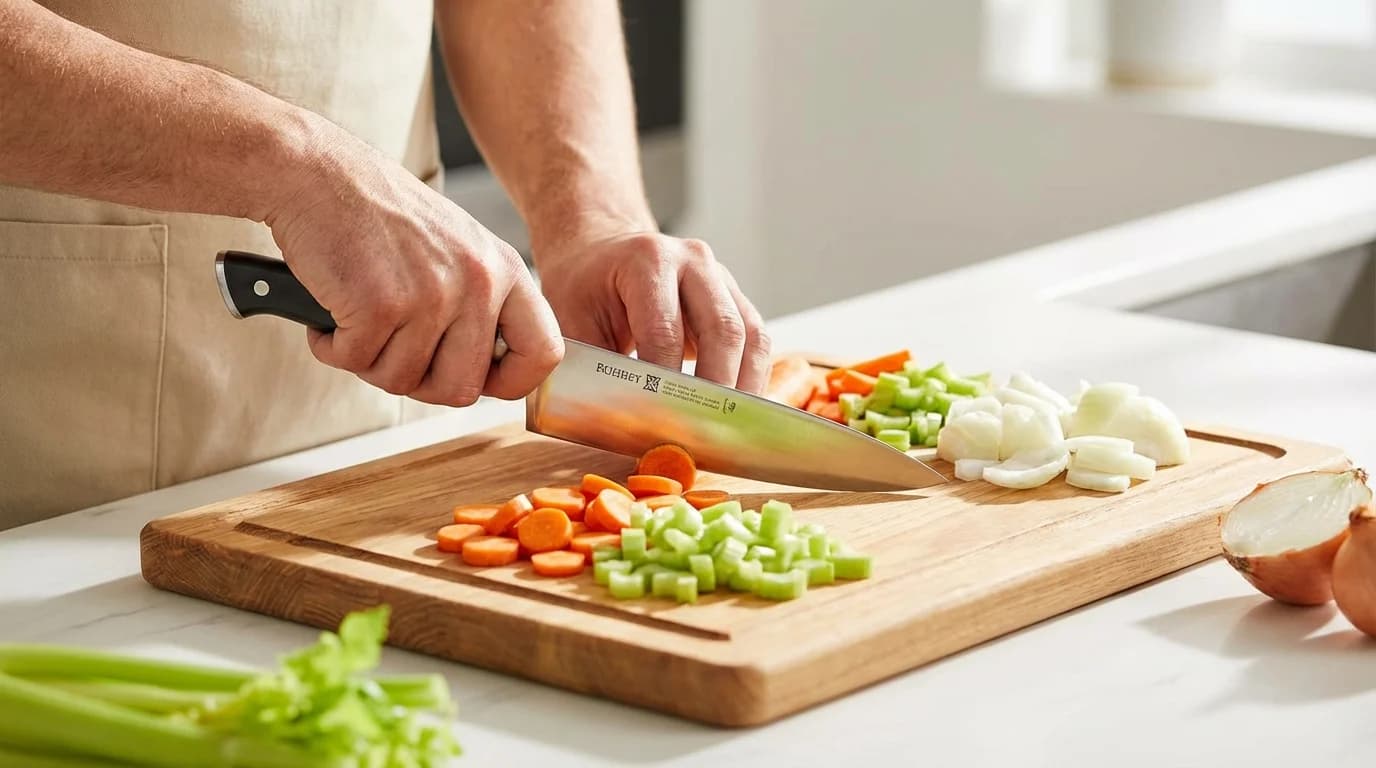
Knife Skills for Beginners: Essential Techniques Every Cook Needs
Proper knife skills are the foundation of efficient, safe, and enjoyable cooking. Whether you're preparing a quick weeknight dinner or tackling an elaborate meal prep session, confident knife work saves time, reduces waste, and produces more consistent results. This comprehensive guide will teach you everything you need to know to wield your kitchen knives like a pro.
Choosing the Right Knife
Before learning techniques, you need the right tools. A beginner needs only three knives:
Chef's Knife (8-10 inches): Your workhorse knife for 90% of cutting tasks. Use it for chopping vegetables, slicing meat, and mincing herbs.
Paring Knife (3-4 inches): Perfect for small, detailed work like peeling, trimming, and deveining shrimp.
Serrated Bread Knife (8-10 inches): Essential for slicing bread, tomatoes, and other foods with tough exteriors and soft interiors.
Invest in quality over quantity. One sharp, well-made chef's knife beats a block of mediocre knives every time.
Knife Safety Fundamentals
Rule 1: A Sharp Knife is Safer Than a Dull One
This seems counterintuitive, but dull knives require more pressure and are more likely to slip, causing injuries. Sharp knives cut cleanly with minimal force, giving you better control.
Rule 2: Never Leave Knives in the Sink
Reaching into soapy water and grabbing a blade is a common cause of kitchen injuries. Wash knives immediately after use and place them on the drying rack.
Rule 3: Use the Right Knife for the Job
Don't use your chef's knife to open packages or pry lids. Misusing knives damages them and risks injury.
Rule 4: Create a Stable Cutting Surface
Place a damp towel under your cutting board to prevent slipping. Never cut on glass, marble, or metal surfaces—they dull blades quickly.
Rule 5: Focus on What You're Doing
Distractions cause accidents. When using a knife, give it your full attention.
The Proper Grip
The Pinch Grip (Professional Method)
This is how chefs hold knives for maximum control:
- Pinch the blade between your thumb and the side of your index finger, right where the blade meets the handle
- Wrap your remaining three fingers around the handle
- Keep your wrist straight and relaxed
- The knife becomes an extension of your arm
This grip feels awkward initially but provides superior control and reduces hand fatigue during extended prep work.
The Handle Grip (Beginner Method)
If the pinch grip feels too uncomfortable:
- Grip the handle with all four fingers
- Rest your thumb on the side of the handle
- Keep your index finger extended along the spine of the blade for guidance
This is less efficient but acceptable as you build confidence.
The Claw Hand: Protecting Your Fingers
Your non-knife hand is just as important as your knife hand. The "claw" position keeps your fingertips safe:
- Curl your fingertips inward, tucking them away from the blade
- Let your knuckles guide the knife blade
- Keep your thumb behind your fingers, never in front
- Apply gentle pressure to stabilize the food
The flat side of the knife should rest against your knuckles, which naturally move backward as you slice, maintaining safe distance from the blade.
Essential Knife Cuts
The Slice
The most basic cutting motion:
- Position the knife tip on the cutting board
- Use a forward and downward rocking motion
- Let the weight of the knife do the work
- Keep the tip in contact with the board throughout the motion
Use this for soft items like mushrooms, cooked meats, or soft vegetables.
The Chop
For larger, harder items:
- Lift the entire knife off the board
- Bring it down with controlled force
- Use the front third of the blade for precision
- Keep your wrist loose to avoid fatigue
Perfect for cutting through butternut squash, cabbage, or large cuts of meat.
The Rock Chop
Ideal for herbs and garlic:
- Keep the tip of the knife on the cutting board
- Rock the handle up and down while moving it in an arc
- Use your free hand to guide the tip (carefully)
- Continue until ingredients are finely minced
The Cross Chop
For quickly breaking down large amounts:
- Gather ingredients in a pile
- Use a rapid rocking motion while moving the knife across the pile
- Periodically gather ingredients back into a pile
- Continue until desired size is achieved
How to Dice an Onion
Dicing onions efficiently is a rite of passage for home cooks. Here's the professional method:
Step 1: Halve the Onion
Cut the onion in half from root to stem, leaving the root end intact on each half.
Step 2: Peel
Remove the papery skin, but leave the root end attached—it holds the onion together during cutting.
Step 3: Make Horizontal Cuts
Place the onion half flat-side down. Make 2-3 horizontal cuts parallel to the cutting board, cutting toward but not through the root end.
Step 4: Make Vertical Cuts
Make vertical cuts perpendicular to the board, again leaving the root intact. Space them according to your desired dice size (1/4 inch for small dice, 1/2 inch for medium).
Step 5: Dice
Make crosswise cuts perpendicular to your vertical cuts. The onion will fall into perfect dice. Discard the root end.
Pro tip: Keep your onion cutting consistent across your recipes for even cooking. Learn more about mise en place for better kitchen organization.
How to Mince Garlic
Method 1: Classic Mince
- Crush the clove with the flat side of your knife to loosen the skin
- Peel and discard skin
- Make thin slices, keeping the tip of the knife on the board
- Rock chop the slices until finely minced
Method 2: Paste Method
Follow the classic mince, then:
- Sprinkle the minced garlic with coarse salt
- Use the flat of your knife to smear and press the garlic into the salt
- Repeat until you have a smooth paste
Julienne: Creating Matchstick Strips
Perfect for stir-fries and salads:
- Square off the vegetable by cutting off the rounded sides
- Cut into 1/8-inch thick planks
- Stack 2-3 planks
- Cut into 1/8-inch thick strips
The result: uniform matchstick pieces that cook evenly.
Chiffonade: Ribboning Leafy Herbs and Greens
For basil, spinach, or other leafy ingredients:
- Stack several leaves on top of each other
- Roll them tightly into a cigar shape
- Slice across the roll to create thin ribbons
- Fluff the ribbons to separate
This technique prevents bruising and creates beautiful, delicate strips.
Common Mistakes to Avoid
Mistake 1: Using a Sawing Motion
Don't saw back and forth with a chef's knife. Use smooth, deliberate slicing motions to maintain control and create clean cuts.
Mistake 2: Cutting Too Fast
Speed comes with practice. Focus on proper technique first; efficiency will follow naturally.
Mistake 3: Applying Too Much Pressure
Let the sharp blade do the work. Excessive force means your knife is dull or you're using poor technique.
Mistake 4: Inconsistent Sizes
Uneven cuts cook unevenly. Take time to make uniform cuts, especially for ingredients that will be cooked together.
Mistake 5: Neglecting Knife Maintenance
Knives need regular honing (weekly) and occasional sharpening (every few months). A honing steel realigns the blade edge, while sharpening removes metal to create a new edge.
Knife Maintenance Basics
Daily Care
- Wash knives by hand immediately after use
- Dry completely before storing
- Never put knives in the dishwasher
- Store in a knife block, on a magnetic strip, or with blade guards
Weekly Honing
- Hold the honing steel vertically with the tip resting on a towel
- Place the knife blade against the steel at a 15-20 degree angle
- Draw the blade down and across the steel from heel to tip
- Repeat 5-10 times on each side
Periodic Sharpening
Have knives professionally sharpened 1-2 times per year, or learn to use a whetstone yourself. A sharp knife makes all these techniques easier and safer.
Practice Exercises
Build your skills with these exercises:
Week 1: Practice your grip and the claw position. Cut carrots into coins, focusing on uniform thickness and safety.
Week 2: Master the onion dice. Dice 2-3 onions until the motion feels natural.
Week 3: Practice julienne cuts with carrots, celery, and bell peppers.
Week 4: Work on mincing garlic and herbs using the rock chop technique.
Putting It All Together
These fundamental skills form the foundation of efficient cooking. As you gain confidence, you'll find yourself preparing ingredients faster and with less stress. Your quick weeknight dinners will come together more smoothly, and complex recipes will feel less intimidating.
Remember that professional chefs have spent thousands of hours developing their knife skills. Be patient with yourself, focus on safety and proper technique over speed, and practice regularly. Even dedicating 10 minutes a few times per week to practice will yield noticeable improvements.
Start with a single technique, master it, then move to the next. Before long, you'll be chopping vegetables with confidence and precision, transforming meal preparation from a chore into an enjoyable part of your cooking routine.
About myrecipe
myrecipe helps families save, organize, and share their favorite recipes in one place. Plan meals, create shopping lists, and preserve your culinary traditions.
Start Organizing Recipes